Showing posts with label Aloe x 'Safari Rose'. Show all posts

Sunday, February 12, 2023

Garden-worthy Aloes

 Aloes come in an astonishing variety of sizes and shapes. They can be trees or small groundcovers, and everything in between. There are over 600 species of Aloes and Aloe-related species (Kew) originating from Africa, Madagascar, and 14 from the Arabian Peninsula, Jordan, and a few from islands in the Indian Ocean. This article will concentrate on some of the smaller, more garden-worthy Aloes for San Diego. 

Aloe striata                                                                                         Sharon Reeve

Many Aloes offset and get bigger over time. Coral Aloe or Aloe striata is a uniquely beautiful single Aloe that gets chunkier with each passing year. The spineless basal rosette is only about a foot high, but the flat-topped floral cluster reaches up another foot. Thick bluish-aqua leaves radiate from the center and have a coral-colored edge that matches the flowers. A subspecies has faint white lines running up the leaves that show in bright light. While this is an attractive sculptural plant when planted alone, it also is very attractive planted in a group or band in front of a solid-colored dark-foliaged plant to show off its sculptural qualities and flashy flowers. Front it with an even bluer Senecio for a pleasing combination. Full sun and infrequent water suit it best. This clean plant requires no maintenance, save the removal of old flowering stems. This plant will tolerate slight freezes only. Aloe striata blooms in winter for about a month.

Aloe x 'Moon Glow'                                                                                                                          Sharon Reeve

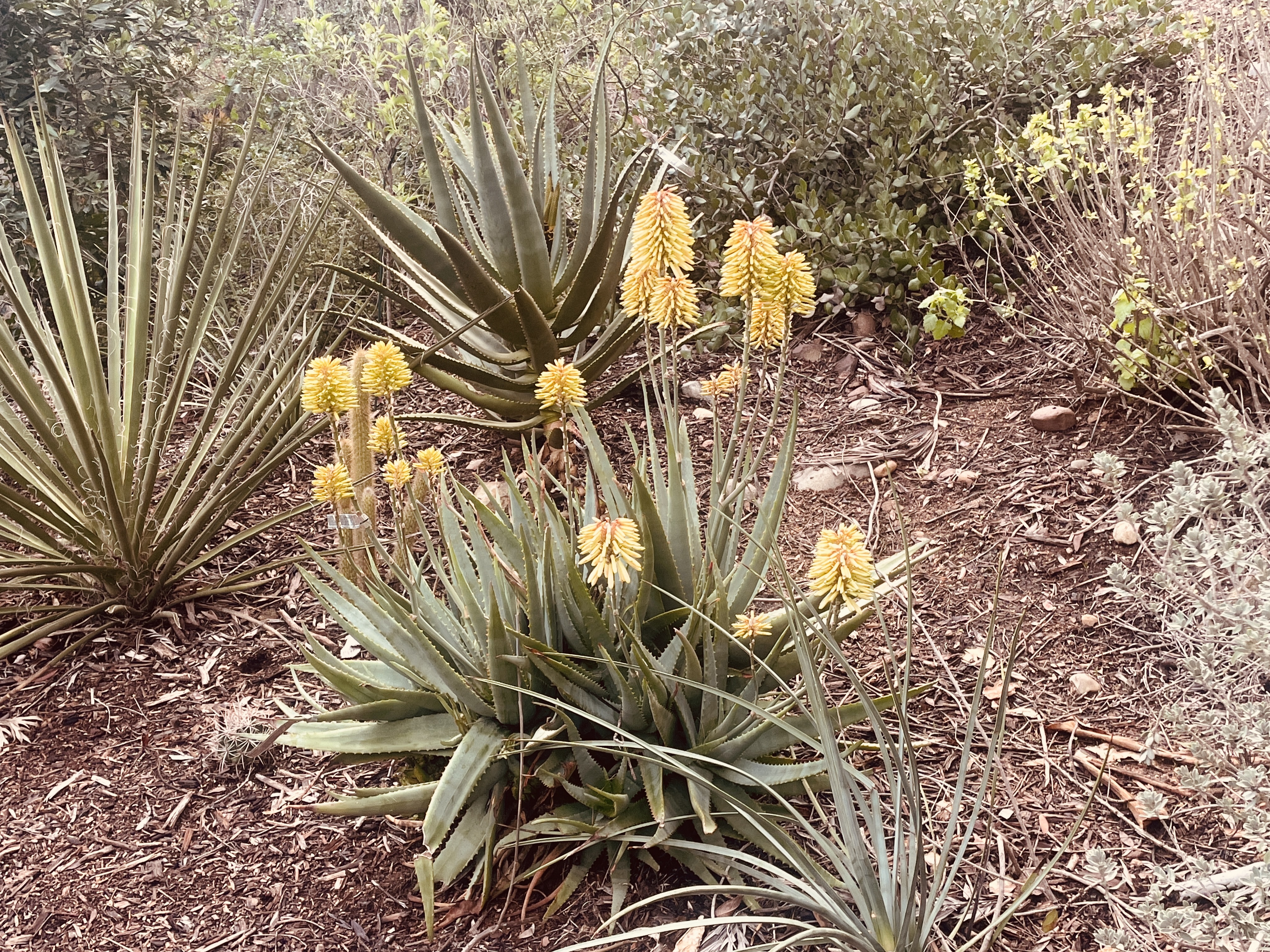
This garden Aloe is the product of a breeding effort by Leo Thamm. The parentage of Aloe x 'Moonglow' is unknown, but the combination of bluish foliage and abundant soft yellow flowers with orange centers is stunningly beautiful and very satisfying. After, many years the plant will offset to a medium-large size of 3-4 feet high and 4 feet wide. You can control the size by pruning after bloom. When it does bloom, it is the star of the garden and an obvious focal point. The soft-colored flowers coordinate well with pastels and white, grey, and silver-foliaged plants, like Kalanchoe bracteata or Dasilyrion wheeleri. Hummingbirds love Aloes, and this is no exception. Once again, full sun and infrequent water are what this plant wants. This is also a long winter bloomer. This is a tough plant that insists on well-draining soil and temperatures above freezing.  

Aloe cameronii                                                                                                                                 Sharon Reeve

Aloe cameronii is much better behaved than the similar, but larger, Aloe arborescens. In the photo above, the plant is 7-8 years old and has expanded to four feet wide and three feet high. This is considered a slow-growing Aloe. Cherry-red flowers are numerous and in proportion with the smaller-scale foliage. In cooler months, the foliage turns a deep forest green, but heat and drought can turn the foliage bronzy orange. Regular water will keep the foliage green. Combine it with Aeonium 'Kiwi' to bring out the red of the flowers. This deep green foliage works well with all kinds of smaller colorful succulents. Rosettes of foliage cut from the base propagate easily. This is one of my favorite plants for creating gardens. Colorful winter blooms can repeat during the year. Even when not in bloom the neat dense basal foliage is refreshing and healthy. This plant needs well-drained soil and full sun. Aloe cameronii can withstand slight freezes. While this plant does not have spines, the leaves are edged with teeth that might lead you to be a little careful.

Aloe 'Blue Elf'                                                                                                                                   Sharon Reeve

If spreading Aloe is more to your liking, this hybrid Aloe 'Blue Elf' may work for you. The narrow upright bluish-green foliage, with hints of orange and red, forms a dense ground cover that is around a foot tall. Plant this on 8-inch centers and in a couple of years you will have a continuous patch of Aloe 'Blue Elf'. In the middle of winter, it sends up one-foot-high slim red-orange spires of flowers.  Hummingbirds regularly come by and sample them all in a systematic fashion. This plant likes well-drained soil and is tolerant of regular water, but can get by on less. In the photo above this vigorous plant is filling a pot. The flowers open from long bloom stalks and open from the bottom up, and bloom for several weeks. The spent flower pedicels give a polka-dot effect to the stalk. This plant is tolerant of hot open exposures but intolerant of salt spray at ocean locations. Remove spent flower stalks after blooming. This plant combines well with low grasses and other succulents. Upright narrow foliage provides a different texture to almost any plant. Be sure to not crowd this plant and allow it to shine alone or in combination.

Aloe x 'Safari Rose'                                                                                                                 Sharon Reeve

Aloe x 'Safari Rose' is another breeding win for garden-worthy Aloes. This small-statured offsetting Aloe comes to us from Alan Wet's breeding program in South Africa. The foliage of this plant reminds me of Aloe x 'Blue Elf' with bigger soft rose flowers grading into white ends. The clump is a foot tall but spreads slowly and increases in height as the plant offsets. Even though it offsets it stays small. The flowers are large in proportion to the foliage. It blooms heavily in the winter and repeats bloom throughout the year. Combine this with a silver-foliaged herb like Teucrium marum or a low-blooming plant like Kalanchoe manginii. The cherry bells and burgundy foliage of this Kalanchoe go well with this Aloe. Blue Senecio serpens, coppery Sedum adolphi, red-rimmed Crassula arborescens, and tri-colored Aeonium 'Sunburst" all look good next to this plant. With these soft rose flowers, there are so many possibilities! Infrequent water and well-draining soil are needed to grow this well. This Aloe is part of the Safari series from Ball Horticulture includes a bi-colored orange and pink-flowered Aloe called 'Safari Sunrise'. There are also 'Safari Sunrise' and 'Safari Orange'.  All excellent garden Aloes.

I love these garden Aloes for their low maintenance, drought tolerance, effortless attractiveness, and months of flowers. They don't need fertilization, but a layer of mulch is always helpful. Hummingbirds appreciate the frequent and abundant flowers. Try them in your garden and you will love them too. 


Tuesday, December 25, 2018

Delightful Garden Aloe - Aloe x 'Safari Rose'

For three years now I have enjoyed a little tough and well-behaved Aloe in my garden called, Aloe x 'Safari Rose'. I don't see it in the garden centers and I am not sure why. It is certainly one of my best plants. It requires no maintenance, is easy to care for, and it performs and looks great all of the time. There is a lot to like about Aloe x 'Safari Rose.'


Aloe x 'Safari Rose'                                                                                                         S. Reeve

At three years this plant is slowly offsetting while maintaining a clearly defined clump. In this photo, it is getting slightly shaded by a Hibiscus so it is blooming more than I expected. The slightly bi-colored and rosy peach-colored blooms come up over a period of time and are long-blooming, from late fall until winter, and it will sometimes throw up a flower-or-two during the year. This is a compact and upright selection with leaves only about a foot long and flower stems about two feet tall. This particular plant was bred for sterility and tends to have larger and more numerous flowers than the straight species. The leaves are toothed and tend to be tipped in a blushing red. 

The whole time, I have had this plant it has shown no indication of disease or Aloe mite. Researching this, revealed that this particular plant was bred for disease resistance. It is said to be extremely resistant to aloe mite, which is looking to be a fearsome foe. Two of my other Aloes had it, and since I garden organically, my options for treating it are limited. One of the Aloes I had to throw away, and the other I cut out the cancerous growth and sprayed with hydrogen peroxide. This is what The Aloe Farm in South Africa says about it, "Hydrogen peroxide 12% (40 volume ) undiluted with wetting agent added can also be useful as part of a treatment program for Aloe cancer. It is always best to physically remove (cut out) the deformities/growths caused by the mite before spraying." No way will I use a toxic neonicotinoid systemic on this problem and poison my bees and hummingbirds. 

This aloe is one of a number in the Safari series developed by Charles Andrew De Wet at his nursery in South Africa. The breeding program started in 1973. In 2007, he chose this plant and named it 'Safari Rose' as it demonstrated superior disease resistance, attractive form, and a long bloom period. There are also 'Safari Sunset', 'Safari Orange', and 'Safari Sunrise'. I liked 'Safari Rose' so much that when I saw 'Safari Sunset' in the store I bought it. 

   Aloe 'Safari Sunset'                                                                                                                                   S. Reeve

This plant has only been in the ground for a month-or-so and it is blooming precociously. Look at the size of that flower spike! So far, it appears that this a faster-growing selection. If this flower size is typical it is clearly an over-achiever. Big flowers are a bonus, but I am also happy that these are also mite resistant because finding aloe mite damage, and cutting it out is not my idea of a good time. 

Hummingbirds and honeybees like the flowers, however, breeding for sterility has reduced the pollen to only a sparse amount. Fortunately, the plant also makes copious amounts of nectar to feed hungry flyers. Aloes are important honey bee plants in South Africa. The flowers open sequentially from the bottom up. This plant needs well-draining soil and can tolerate temperatures down to 23-25 degrees F. If you have a garden in Zones 9-11 this is a great plant for you. Even if you don't, this would be a good one for a container.