 |
| Felicia amelloides S. Reeve
If you say you have a black thumb and kill every plant you own, try this one. It really is a "no-brainer." It has a wonderful growing habit. It is a neat and tidy little mound of foliage and flowers without pruning or training. The flowers are either blooming or unnoticeable when they are finished and fade away. This plant blooms all of the time! It is so funny sometimes, I go outside and nothing else is really blooming, but there is Felicia with her riot of cheerful flowers, blooming her head off!

Felicia amelloides S. Reeve
My plant is 27 inches across and 16 inches high. The flowers are about 4-6 inches above the foliage which is about 10 inches tall. The plant is gradually increasing in diameter. This plant requires no staking. Flowers are held aloft on strong stems that stay upright. Flower petals or ray flowers are an intense shade of blue-lavender, a rare and welcome color in the garden. There is no gradation in the color of the petals, they are a solid matte blue color, and about the size of a 50 cent piece. Bees love blue flowers, and this is no exception. As a member of the Asteraceae, the compound flower head or capitulum provide an easy-landing platform of ray flowers with yellow disk flowers in the center. This plant is the "7-Eleven" of flowers with fast and easy access to nectar and pollen. Felicia, like many members of the Asteraceae are pollinated by bees also called melittophily. Individual flowers in the flower head are small and their nectar is easily obtained by short-tongued bees and small flying insects, so this is a popular plant! The flowers close at night and on overcast days. Like similar members of the Asteraceae, this plant employs a pollination strategy designed to prevent self-pollination called "plunger pollination." The pollen matures earlier while the stigma is unreceptive to encourage cross-pollination with other plants. It is called plunger pollination because the unreceptive stigma/style pushes the pollen from the fused anthers up through the tube formed by the anthers, so visiting insects can take it to other plants.

Felicia amelloides with honey bee S. Reeve
There are 79 species of Felicia in South Africa with 84 species in total. Felicia amelloides is a common coastal plant in South Africa. For a plant that flowers almost constantly it is remarkably long-lived. I have read reports of 15-year-old plants, but five years seems more typical. It is a tough plant too, and one of the few able to live under native oaks.

Felicia amelloides S. Reeve
Stems and leaves are covered in short stiff hairs and have a sandpapery feel. Leaves are opposite, variable in form, from elliptical to spatulate, and have entire margins. After pollination, the flowers shrink back into the plant and form seeds. This means the dried flowers are not readily visible while the beautiful flowers are held high. Below is a ripening seed head with feathery pappus waiting to carry the mature seeds on the wind. This plant starts easily from spring cuttings.

Felicia amelloides S. Reeve
If the summer is hot the flowering can slow. At any time the plant gets too big or has an abundance of dried flowering stems, it can be cut back to encourage more flowers and a better growth pattern. I just grab a handful and trim it. This is very easy to do. Highly fertilized plants do not bloom as well. Also, this plant does not do well in humid hot summer weather but prefers semi-arid locations with sandy, well-drained soil. It is hardy down to 20-25 degrees F. So if you are frustrated in your attempts to successfully grow plants, give this one a try.
|
Showing posts with label easy. Show all posts
Showing posts with label easy. Show all posts
Sunday, March 10, 2019
If You Think You have a Black Thumb Start with Felicia amelloides
If happiness were made into a plant it would look like Felicia amelloides. It just looks like it is smiling all of the time, and not one of those little lip smiles either, but big fat irrepressible toothy grins all day long. "Felicia" means "happy" in Latin so they thought it was a happy plant too.

Thursday, June 7, 2018
Little Salvia that Packs a Punch!
 |
| Salvia chamaedryoides S. Reeve |
 |
| Bed of Salvia chamaedryoides with Furcraea foetida 'Mediopicta' and Romneya coulteri S. Reeve |
 |
| Flower spikes of Salvia chamaedryoides |
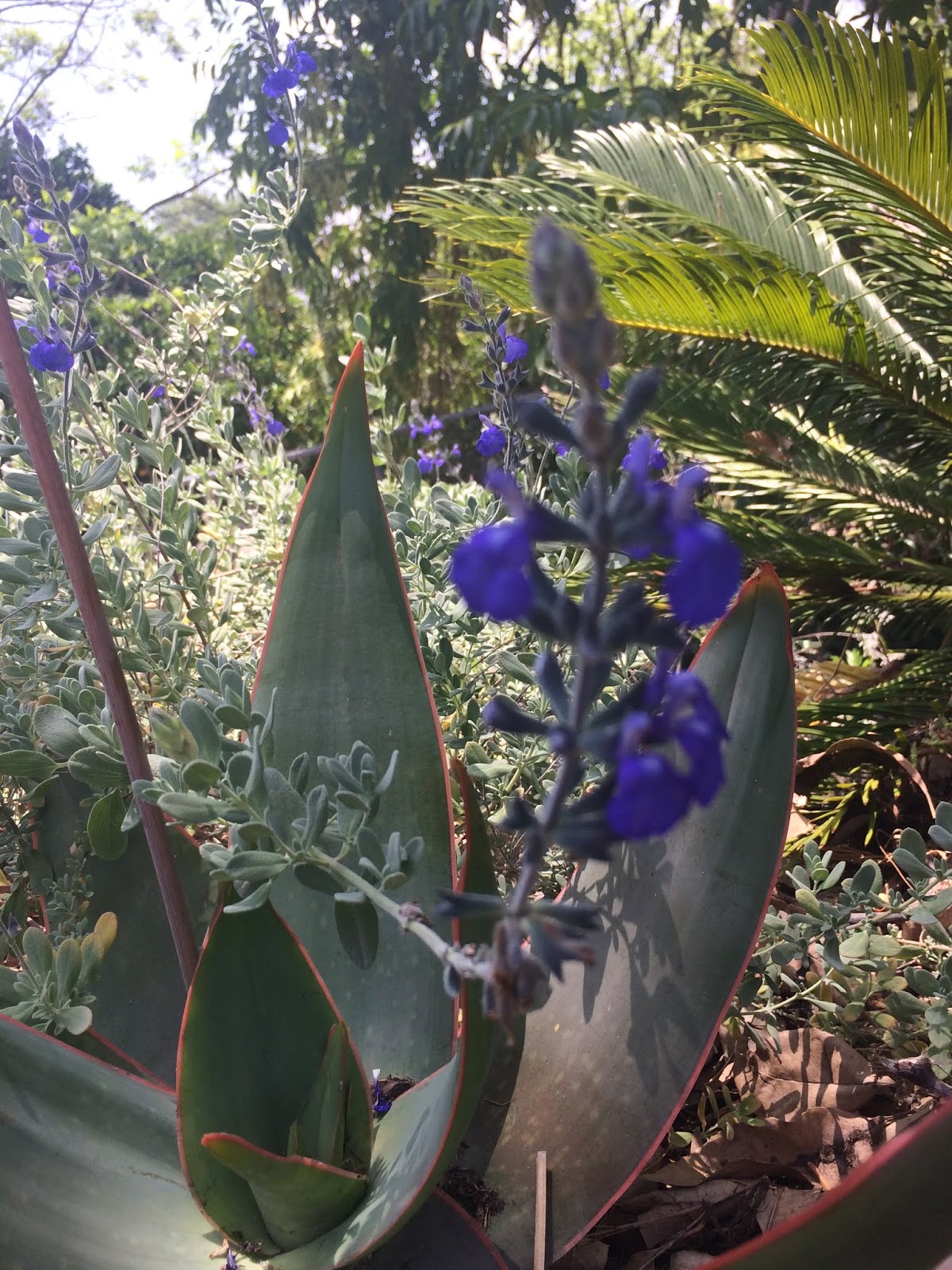 |
| Salvia chamaedryoides in bloom with Aloe striata S. Reeve |
While generally easy-care this plant must have excellent drainage. It can certainly get by on very little water but looks much better with periodic water. I probably water around every 10 days. Even though it is technically hardy to freezes if it gets wet during the winter and the soil does not drain well this will take it out. Winter wet and cold are a lethal combination. I found no less than five "common names" for this plant so I will stick with Salvia chamaedryoides. Takes a few seconds to master the pronunciation, but at least we know what we are talking about. Because of the distinctive aromatic furry foliage, this plant is deer and rabbit proof. Look for this plant if you are tired of weeding and want a plant that combines well with everything. The hummingbirds will thank you!
Subscribe to:
Posts (Atom)