Sunday, September 9, 2018

Anisacanthus quadrifidus var. wrightii is a tough heat-tolerant hummingbird plant

For some reason, I have not written about this plant before even though it is so obviously a great plant for the semi-arid South West. Probably because it is such a no-brainer that I rarely think about it. Anisacanthus quadrifidus var. wrightii is a large mouthful of a plant name or you can just call it Flame Acanthus. It is super easy in my garden and long-blooming. It starts blooming when the weather turns hot and keeps blooming into the fall. It is a small shrub, about four feet wide and four feet tall. Here is a photo of numerous young buds stacked and ready to open. 
     Anisacanthus buds                                                                                                                               S. Reeve

It takes hard pruning really easily, and it improves the growth habit by making it fuller after pruning. Feel free to prune it to the ground in the late winter, and it will reward you with dense fresh new growth and abundant flowers all through the summer. Pruning does improve the growth habit, as it can be a little sparse on top and unruly if left to its own devices. The skinny foliage is a nice rich green that doesn't appear to suffer in the slightest bit when the temperatures rocket upward. Drought tolerant too as I have some that get no irrigation and they do just fine. A little water does mean more flowers for a longer period of time though. While it is native to dry limestone soils in Texas and Mexico, it is adaptable to other conditions. Like other Texas plants, it responds well to water in the summer with profuse flushes of new blooms. Hardy to 10 degrees F. Speaking of adaptability, Tony Avent does sell this plant at his Raleigh, NC nursery, Plant Delights. I ordered it several times to grow in my Zone 8 Athens, GA garden but it never survived in spite of me desperately wanting it to. Supposedly it grows in Houston, but it did not grow in Athens, GA. Not sure why the difference?


    Anisacanthus quadrifidus var. wrightii                                                                                                    S. Reeve

It will even grow in a little shade. It does not need full sun to bloom well, but it blooms better in full sun with additional water. As you can see the flowers are made for hummingbirds and they get lots of visitors! The petals and sepals are both fused into a tube at the base. The petals open out into four lobes that irresistibly invite hummingbirds to dine. Anisacanthus is in the Acanthaceae Family which also includes Justicias and Thunbergias--other hummingbird pollinated genera. One characteristic of Acanthaceae that is unusual is the opposite arrangement of leaves. Not too many plants have opposite leaves. 
Photo of the jaculator the little prong on the right side of the seed.                         Photo by Hugh Wilson


Another characteristic of these plants that I am not too pleased with is its exploding brown seed capsules that launch seeds several feet away. Mind you, not a bad strategy for increasing the population, but many of these seeds sprout, so you need to be ruthless about weeding them out as you see them. These are a little blurry but they show the seed capsule beginning to form. This is the little club-like structure with the filament coming out of the end. 
                                                                                                                                                S. Reeve
             Seed capsules                                                                                                                S. Reeve

Now that I have rabbits in my yard the seedlings are less of a problem because the rabbits love to eat new young plants. The mechanism that flings the seeds is called a "jaculator." It is a rigid hook-shaped structure or modified funiculus that catapults the seeds from the plant. A funiculus is a plant structure that attaches the ovule to the placenta, and that is generally its main function, but in the case of this plant, this funiculus also functions as a jaculator propelling black seeds after the brown capsule explosively opens.

 Anisacanthus quadrifidus var. wrightii blooms                                                                                           S. Reeve

What I love best about this plant is it is such a great source of nourishment for my local hummingbirds without requiring a lot of input from me. I don't fertilize at all or water much and it is just a non-stop blooming machine. The plant is deer resistant too. I also love knowing I can prune it and it doesn't mind the interference and it comes back better because of it. The flowers are at the ends of branches so place it with a smaller blooming plant in front to highlight the higher blooms. It must have well-drained soil to do well.

Sunday, August 19, 2018

Heat Lover and Hummingbird Treat!

 Russelia equisetiformis inflorescence                                                        S. Reeve

This plant is not new to me, I have always admired Russelia equisetiformis or firecracker flower, but didn't live where I could grow it. Mistakenly, I thought it was a tough plant to grow. Up until it got hot this summer I was pretty sure it was a tough plant to grow. You see I planted it about 6 months ago and it just sat there. I bought from a vendor on Ebay because they grew this without neonicotinoid pesticides. Before I buy a plant I need assurance it is not grown using these systemic pesticides as they harm wildlife, especially bees. The spot I chose was at the edge of a stucco wall so my thought was it will cascade down eventually. Well, this little sleeper plant exploded in growth once it was over 80 degrees F. It quickly increased in size by 4-6 times its original size. Heat lovers definitely have a place here in my summer hot garden (and getting hotter-thank you global warming!). Also, when we had those couple days of odd temperature spikes in the mid-90s and many of my plants exhibited some kind of heat damage, while this plant did not. 
Young immature plant starting to cascade
This is a medium green evergreen shrub-like cascading plant with flowers from spring until frost. I wonder if it will keep flowering if there is no frost? That would be nice. From what I am reading it can bloom year round in frost-free gardens. This plant comes from Mexico and Latin America. Of course, the 1 inch long red flowers are pollinated by hummingbirds and that is why it is in my garden! Formerly in the Scrophulariaceae family and now in the Plantaginaceae. The species name, "equisetiformis" refers to its similarity to horsetail rush or Equisetum. Russelia refers to Scottish naturalist Alexander Russell from the 1700s. Skinny stems are angular and rush-like and the leaves have been reduced to scales. Young wiry stems grow vertically for a time and eventually turn downward in a free fall pendulous fashion. New stems just starting out give the plant a 'bad hair day" look. With time the stems increase and the flowers increase it is definitely in the Cousin Itt category with a dense mound of foliage and flowers. 
Planted as a hedge 
There several selections of colors, there is red of, course, but also coral, white, orange, pink, and yellow flowers. There is a closely related species of Russelia called Russelia sarmentosa with smaller red flowers that is more shrub-like. 
Photo by Alan Lorence
Technically the inflorescence is a terminal cyme, but unlike a single-flowered terminal cyme, as most are, this plant has paired terminal flowers or a "pair-flowered" cyme. Only three families have this condition. Here is a diagram of a normal cyme and a pair-flowered cyme so you can see the difference. These diagrams are from the Annals of Botany. 
Anton Weber; Pair-flowered cymes in the Lamiales: structure, distribution, and origin, Annals of Botany, Volume 112, Issue 8, 1 November 2013, Pages 1577–1595, https://doi.org/10.1093/aob/mct156
                                                     
Ordinary Cyme with single flower terminating each cyme unit

Pair-flowered cyme with two terminal flowers in each cyme unit
Close up of individual flowers                                                                     S. Reeve
Little blackish-red pearl-like buds open up into the coral-red bilaterally symmetrical tubular flowers. You can barely see two of four stamens bearing pollen and a black female stigma. Looking at the arrangement it is easy to see that if the hummingbird sticks its beak in this flower she will have pollen deposited on her only to have it make contact with the stigma in the next flower she visits. Nice system Russelia!

This plant is not just another pretty face. It has many uses in pharmacology. In Nigeria, it is used to promote hair growth, to treat malaria, cancer, diabetes, and inflammatory disorders. In Colombia it is used for kidney stones. The plant has antibacterial, antimicrobial, antioxidant, analgesic, and cytotoxic properties.

This plant can reach 4 feet long and much wider at maturity. It looks wonderful draped over a wall and growing in a tall pot. Can you imagine this in a tall chartreuse ceramic pot? Nice! 
This plant needs well-drained soil, full sun, and heat. It can even grow in a hot place like Phoenix. Sunset Western Garden book says it needs moderate to regular water and can take temperatures down to 20 degrees F. I don't water mine that much and it looks fine. I have also read more water and fertilizer results in much better lusher growth. I am not much of a fertilizer user but I might try an organic fertilizer on it and some extra water to see what happens. Right now, I water once a week and it is the summer and it is doing just great. The stems can root where they touch the ground if the soil is kept moist. You can also start new plants with stem tip cuttings or layering. I love this plant because it is easy and because it throws out an abundance of bright red flowers for me and the hummingbirds.


Saturday, August 4, 2018

Mutant Bougainvillea

Do you know Bougainvillea 'Torch Glow'? It is a cool plant! Get a load of this photo.
Bougainvillea 'Torch Glow' blooms                                                                                          S. Reeve
This is unlike any Bougainvillea you have previously grown. The plant happened as a chance mutation of a normal bougainvillea. The plant was patented in 1988. Unlike a normal bougainvillea this plant has really congested internodes. Here is a photo of a normal blooming bougainvillea for comparison.
Normal Bougainvillea 

See how different it is? 'Torch Glow' has many blooming flowers bunched up on the ends of branches from ten to forty centimeters (4 to 16 inches) down from the tips of the stems. The flowering ends of stems appear to be densely flowering cylindrical spikes or torches. The plant is also very upright growing and more like a shrub than a vine. Typically bougainvillea have vine-like stems that are 30 feet long. In its native habitat, thorns help it climb to the sun. Bougainvillea 'Torch Glow' stays around six feet tall and four feet wide and looks like a shrub. 'Torch Glow' looks like the normally 30 foot long stems were compressed into 6 feet with all of the flowers bunched at the tips of the branches. 
Photo from Desert Horizon Nursery

Bougainvillea 'Torch Glow'                                                                                                                     S. Reeve

Isn't this plant amazing! Sometimes when I drive past this plant I do a double take because at first glance I think it is an azalea. Do you see what I mean in this second photo? The branches all come from the base of the plant. I have a neighbor who has limbed up B. 'Torch Glow' into a small tree and it looks cool. In the first photo of the shrub, it doesn't look like it was ever pruned. You can make it look more like a shrub if you trim some of the long wands of leaves. This plant, like regular bougainvilleas, blooms for a long time. The flowers are actually only the little white bloom and are surrounded by colored bracts, like a poinsettia. The bracts are tougher than petals and can stick around for months. It blooms in response to day length in the spring and fall. The plant is pollinated by hummingbirds. Bougainvillea is in the Nyctaginaceae family.

As with all bougainvillea, try not to disturb the roots when planting. For some reason, bougainvillea is especially sensitive to root disturbance and the growth can be set back for quite a while if the roots are disturbed. Bougainvillea has two growth cycles, either vegetative or blooming. After it finishes blooming, it grows stems and leaves. If there is plenty of light, and things aren’t too cushy, the plant will also form floral buds. Once the vegetative cycle is completed the plant will flower again, typically, in the spring and fall, when the daylight and night lengths are approximately the same. Besides high sunlight and heat levels, the plant responds to stress and will bloom again, if you skimp on water and avoid high nitrogen fertilizer. 

The more sunlight and heat you can provide-- the better. This plant thrives on neglect. If you treat it too nicely, it will fail to rebloom and continue to grow only stems and leaves. Let your plant dry out, quite a bit, before watering again. Watch carefully, and allow the leaves to almost wilt, before watering again. Make sure the soil drains well. This plant grows best in sandy low fertility soil. It will not tolerate heavy clay or badly draining soil. If you treat it too well, with abundant water and fertilizer, it will just grow leaves. 

Prune right after blooming. This plant is hardy to Zone 10 and will not tolerate freezes. It thrives on heat. This is not a problem where I live, but you may need to place it in a south-facing position, and siting it next to a cement sidewalk or masonry wall will increase the heat if necessary. You can, and people certainly do, overwinter bougainvillea all over the country if they are in a less-than-10 zone. I love this plant! Isn't it cool?
Long wand of flowers at the end of B. 'Torch Glow' stems                                                         S. Reeve


Monday, July 30, 2018

Dombeya x 'Seminole' Loves the Heat

My garden is inland a little bit from San Diego so we get heat in the summer. I love those plants that like heat. You know the ones I mean, just as I am wilting, they are perking up and look positively chipper as the temperature climbs. Their growth accelerates as temperatures go above 80 degrees F. Dombeya x 'Seminole' is one such plant. Planted last fall as the temperatures were cooler, it kind of sat there for a few months--that is-- until it got hot, and now it is putting on impressive growth. Not sure what made me try it, it is supposed to really like water, and I never intended to put water lovers in my garden. Once a week this shrub gets maybe 30 seconds of water from the hose and it is doing well. I have it sited under the high shade of a tree it is refreshingly dark green and robust on that amount of water. The leaves are large and really green like a Hydrangea macrophylla and because of this is often called, "Tropical Rose Hydrangea."
Dombeya x 'Seminole' or Dombeya burgessiae 'Seminole'                                                                     S. Reeve

So far the growth habit is full and it hasn't required pruning. It takes well to pruning and can be kept 3-5 feet high and wide pretty easily even though it wants to be 8 feet tall and wide. Dombeya is in the Malvaceae. Originally this species comes from East Africa and was named for Joseph Dombey, a French botanist from the eighteenth century. This plant is a hybrid created in 1973 by crossing two selections of Dombeya burgessiae, E-29 and 'Rosemound'. This created a smaller denser plant with brighter pink flowers. The flowers are held on the outside and are very showy, occurring in large clusters of vivid pink petals. Each flower is 1-1.5 inches. The flowers are not fragrant. 
               Blooming Dombeya x 'Seminole'    

This is a long-blooming shrub. It starts in the fall and blooms until the spring. Large bowl-shaped flowers are popular with bees, butterflies, and hummingbirds, making this a "must-have" wildlife plant for my garden. 
Costa's Hummingbird on Dombeya x 'Seminole'                                                                                   Pedro Lastra

This plant also does well in a pot. It is a precocious flower machine and will bloom very young. If you are in a colder zone, you could try it in a pot and take it in in the winter. Dombeya burgessiae 'Seminole' can take pretty radical pruning too and still come back just fine. Prune after the blooms stop in the spring. It is not cold tolerant though and is rated USDA Cold Hardiness Zone 9 and higher. Zone 9 is a little iffy though as this plant does not tolerate freezing temperatures at all. It is evergreen here in Zone 10b. It needs well-draining alkaline to slightly acidic soil which I have here. Not that I fertilize anything, but I wouldn't use chemical fertilizer on this plant, as I can imagine one of the those "miracle" fertilizers would cause lanky unattractive forced growth. The fruit is a five-chambered oval brown capsule. 
Nobuhiro Suhara photographer

Leaves appear healthy and I have not seen any pests on this plant. What remains to be seen is how well it flowers in a little shade. I have a feeling it will bloom just fine.


Thursday, July 19, 2018

Fancy Echeveria!

  Echeveria 'Andromeda'                                                                                                                S. Reeve
Echeveria 'Andromeda' has Mother-of-Pearl opalescent coloring that is difficult to believe unless you see it. I see pink/coral edges, blue inner petals, yellow centers that grade into blue and coral and silvery tones too. The coloring of sunsets and seas in every wavy leaf. What an amazing plant! This is a new plant for me and I was worried it would be finicky and difficult to grow, but it has been quite the opposite. Once I planted three of them they all took off and grew to large platter proportions. One was completely eaten (by rabbits?) only to return and almost catch up to its cohorts. In fact, as I walked by what remained of the plant, I silently gave it its last rites, thinking it was far too gone to ever come back. Was I ever surprised to notice it the other day almost as large as the unmolested other two! Impressively strong grower so far. 
Blooming Echeveria 'Andromeda'                                                                                                        S. Reeve
So here it is the middle of July and the plant shoots up these cartoonishly colored bloom spikes. The spikes are much more substantial than the slender horizontal spikes of the Dudleya pulverulenta. They look like they hummingbirds might like them, but so far, I have not observed any takers. This plant is so visually satisfying with its blue bracts and Pepto Bismol pink blooms on Helicoid cymes. According to the patent description, the flowers are 2.4 cm long and are large for the genus. This plant was bred by the famous Renee O'Connell in Escondido. My plants are in a little bit of shade. Even in an inland location, where we had a 102F degree day these plants were not phased in the slightest. Unlike Dudleya, Echeveria appreciates and requires summer irrigation. I am new to this genus and I am astounded by the diversity of coloration and shapes. Pretty sure some botanist will determine that there is more than one genus here and start dividing it further. Splitters--hmmph! 


Echeveria is in the large Family of Crassulaceae. Crassulaceae means "succulent little plant" and that is almost right with Echeveria 'Andromeda' except I would say "succulent big plant."  Native to cool mountains in Mexico and South America with one species outlier in Texas. Keep them dry in the winter and they will be more cold hardy, down to 20-25F. All members of the genus Echeveria have CAM or Crassulacean Acid Metabolism. CAM plants represent 7% of vascular plant species. Normally, plants open their stomata during the day to fix carbon dioxide during photosynthesis. In CAM the plant opens their stomata at night and has the ability to store carbon dioxide until it is needed during daylight. This evolutionary modification saves water that would normally escape at a greater rate during the warmer daytime through open stomata. This strategy has mainly evolved in arid and semi-arid water-limited environments.

I am really enjoying living here in Southern California and growing all of these cool succulents.  I water once a week and that seems to be enough. They seem to like my sandy loam soil. Good drainage is necessary to grow these well. They do not tolerate freezing temperatures and tend to sulk if temperatures go below 50 degrees F. People can and do grow these indoors, but it would have to be in a very sunny window. If you do grow these in pots use a good quality cactus soil to give them the drainage they insist on. Try to avoid wetting the leaves when applying water. I'm hooked. These succulents intrigue me with their jewel box colors and variety of size and shapes.


Saturday, June 16, 2018

Is That Flower Real?


Tigridia pavonia has an unbelievable flower! I don't know if the bulbs I got were special but each flower is eight inches across. What I have read says the flowers are 4-6 inches across. These are so ridiculously huge I cannot believe it! I keep looking at my plant and asking, "Are you for real?" For me, this shade of red-orange is just the most perfect shade of red. I love red, but red-orange makes my heart skip a beat. 
Tigridia pavonia is one of at least 45 species in the Tigridia genus. The common name is Tiger Flower. Nearly all of them are native to Mexico, with some from Bolivia, Ecuador, Guatemala, and Peru.  With their intricate markings, they remind me of our native Calochortus, which can get almost silly with their fanciness. The species has great genetic diversity and the flowers have a wide array of colors and markings. Extensive breeding has produced colors ranging from white, yellow, rose, orange, red, and pink. 
Flowers face the sky and are short-lived, lasting only one day. The night before the flower blooms the pedicel pushes the flower from the spathe. They bloom in the morning and close by the end of the day. Flowers get floppy in the late afternoon right before they close. Tigridia flowers precociously, sometimes the first year after growing from seed in warmer climates. Seed germinates easily in the spring in moist warm media. Seeds form in long pods and look a bit like small rounded brown apple seeds. If you live in sunny Southern California it is a good idea to buy bulbs from a dealer who has collected plants from warmer locations in Mexico, rather than bred in the Netherlands, for better performance in our climate. The stamen filaments of the flower are fused into a column with three large anthers full of pollen on top with a branched style with three deeply divided arms. At the base of the stigma/style are three pools of clear liquid, which I assume are nectar? Tigridia flowers are pollinated by bees, wasps, and flies. 

This bulb is in the Iridaceae family. Numerous publications mention this is a corm and not a bulb, but I also read the opposite. So far, I believe it is a bulb. Tigridia pavonia's long leaves are unusual as they are accordion-pleated or plicate. Lengthwise folds help the thin lance-shaped leaves stand up. Bulbs offset readily and with time produce more and more flowers. My plant is flowering now in the middle of June. Most descriptions of bloom time state that it is a summer or late summer bloomer. The bulb blooms through a succession of ripening buds over several weeks. It is a good idea to divide this plant every 3-4 years if blooms diminish.
Make sure this plant gets watered while it is blooming. By fall the foliage disappears and the plant is dormant until spring. This plant must have a warm position and well-draining soil. The books say it is deer and rabbit-resistant, but my rabbits consider Tigridia a favorite meal. I am using a taste repellent on my plants to keep them from munching. Gophers, too, find this bulb a tasty treat. As long as the soil is well-drained, especially while they are dormant in the winter, they are reportedly hardy to USDA Cold Hardiness Zone 7, and definitely hardy to Zone 8. There is a pure white unspotted form called Tigridia pavonia 'Alba Immaculata'. A yellow spotted form is called Tigridia pavonia 'Aurea'. Aztecs cultivated this plant as food by roasting the bulbs to reduce the calcium oxalate content. 

As long as you have a warm spot, well-drained soil and can keep these bulbs dry in the winter, you should find this plant grows really easily. The flowers are incredible!


Thursday, June 7, 2018

Little Salvia that Packs a Punch!

Salvia chamaedryoides                                                                                                                            S. Reeve
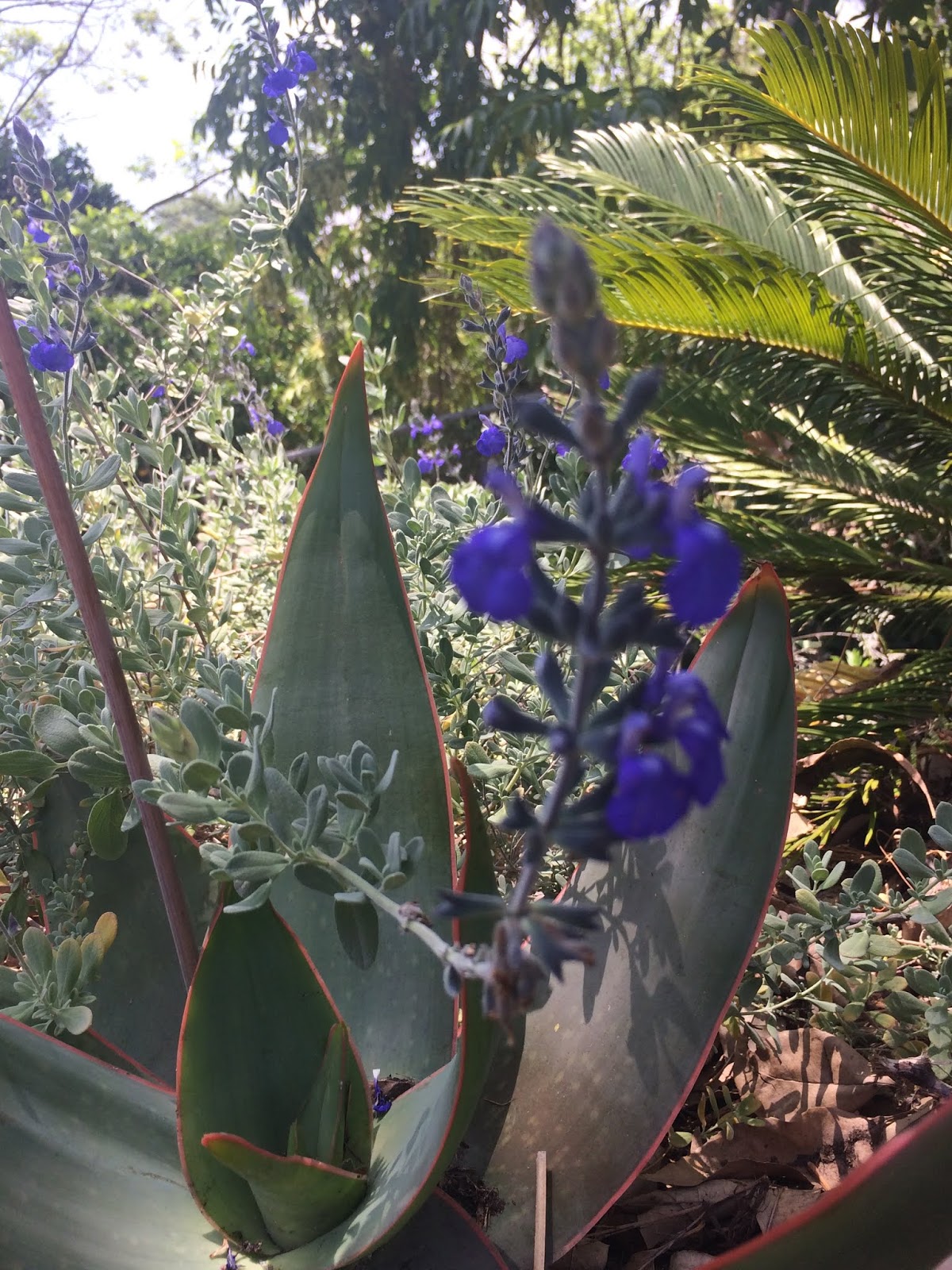
I love this little perennial! This is Salvia chamaedryoides a drought-tolerant perennial from Mexico. It is clothed in soft fuzzy aromatic silvery-gray foliage that mixes well with other arid land plants. After a time in full sun it comes in thick and low, about one foot tall, and chokes out weeds. Hummingbirds love it! It takes a couple of years to get growth like this in a bed. It will tolerate a little shade as it seems to be used to skirting taller plants. As perennials go it is unobtrusive and very attractive even when not in bloom, although, it seems to be in bloom all of the time. It is a good solid workhorse that does its job without shouting. The main blooming period is in the spring/summer for several months and it continues into the fall/winter, with another burst of blooms after the heat of the summer. The only time when blooms are less numerous is in the winter, but it still blooms. In the fall it can look a little rough when it is covered in old bloom stalks, but a quick haircut neatens it up in no time. Just grab a handful of what is sticking up into the air and cut it off. It is as simple as that. 
Bed of Salvia chamaedryoides with Furcraea foetida 'Mediopicta' and Romneya coulteri                       S. Reeve
 This plant does root unfrequently at the nodes, but this is a good thing if you want it to spread. It is not a thug by any means, and as gardeners, we know a thug when we see one! If the plant goes where it is not desired you can quickly grab a hunk and trim it off. If you find an occasional rooted portion, yank it out of the ground and replant elsewhere if you desire. Salvia chamaedryoides roots shallowly and is effortless to pull out. It also roots easily if transplanted. For me, this is as close to a "no-brainer" plant as I can imagine.  Also if you have a handful of unrooted trimmings some will root if you just cover the lower nodes with soil, and give them a little water. I have a bed of this plant in full sun and it is around 6 feet by 6 feet in several years. Maintenance is as I described, trimming off spent bloom spikes and pruning back straggler edges. The spent bloom spikes are barely visible until there are many of them because they are a fine spike with no flowers. They become visible because they age to a straw color. The bloom spike is low and short and it blooms from the bottom up so there is an extended bloom period for each spike. Here is a photo.
Flower spikes of Salvia chamaedryoides
At one time I had one of the selections of Salvia chamaedryoides, but I think this is the straight species. The flowers are medium/dark true blue with two tiny nectar guides on the lower and upper parts of the corolla. It would be interesting to see this under ultraviolet lights to see what the pollinators see.
Salvia chamaedryoides in bloom with Aloe striata                                      S. Reeve
This plant is hardy to 20 degrees F. It combines well with pretty much everything. The orange edge of Aloe striata leaves and the orange of the Aloe bloom are a nice color complement to the deep blue blooms. I also like combinging is with clear yellow Argyranthemum frutescens 'Beauty Yellow', Acaulis tetraneuris, Agastache 'Arizona Sun' and Euryops pectinatus. Add in Salvia 'Fire Dancer' for some primary color action. Grasses like Festuca glauca would be nice too. There is a selection called 'Marine Blue' that is supposed to be superior, although, I wonder how it could be? It remains unknown but Salvia chamaedryoides 'Marine Blue' is suspected to the product of Salvia chamaedryoides and, possibly, another species. The flowers are a darker blue and the foliage looks greener to me. It comes in thicker and a little taller too. It is more frost tolerant to 10-15 degrees F. 


While generally easy-care this plant must have excellent drainage. It can certainly get by on very little water but looks much better with periodic water. I probably water around every 10 days. Even though it is technically hardy to freezes if it gets wet during the winter and the soil does not drain well this will take it out. Winter wet and cold are a lethal combination. I found no less than five "common names" for this plant so I will stick with Salvia chamaedryoides. Takes a few seconds to master the pronunciation, but at least we know what we are talking about. Because of the distinctive aromatic furry foliage, this plant is deer and rabbit proof. Look for this plant if you are tired of weeding and want a plant that combines well with everything. The hummingbirds will thank you!